Some memories stay with a woman forever. Not because they were extraordinary, but because they carried warmth, familiarity, and emotion that quietly settled into the heart over time. For me, one such memory is watching my mother get ready for weddings and festivals in her Kanjeevaram sarees. I still remember sitting on the edge of the bed as she unfolded those silks carefully, almost reverently, smoothing every pleat with patience before draping it around herself. The room would smell of sandalwood, jasmine flowers, and freshly ironed silk. Even before I understood fashion, I understood that these sarees were special.
As a child, I used to open her saree cupboard whenever she was away. Between neatly stacked silks wrapped in soft cotton cloth, there would always be a few Kanjeevarams that instantly drew my attention. Deep maroons with gold zari, emerald greens with temple borders, royal blues that shimmered softly under the light. I would run my fingers across the silk and wonder why they looked so different from every other saree. Today, years later, I realize it was not just their richness that made them unforgettable. It was the emotion attached to them.
Every Kanjeevaram in a woman’s wardrobe has a story. One may have been worn at her wedding. Another gifted by her parents after her first child was born. One might remind her of a sister’s wedding, another of a festival celebration where the entire family gathered after years apart. Unlike most clothes that simply come and go with changing trends, Kanjeevaram sarees become deeply personal over time. They absorb memories quietly and hold on to them for decades.
I think that is why women never truly part with their Kanjeevarams. Even when wardrobes change and fashion evolves, these sarees remain carefully preserved. Folded neatly. Protected lovingly. Passed down gently. Somewhere between tradition and sentiment, they stop being garments and become heirlooms.
I bought my first Kanjeevaram saree in my late twenties. It was not for a wedding or a grand occasion. I simply remember feeling ready for one. I wanted to own something timeless, something that would stay with me for years instead of fading away after a season. When the saree was opened before me, I remember touching the silk and immediately noticing its weight and texture. It felt luxurious, but also grounding. There was a certain dignity in it that I cannot fully explain in words.
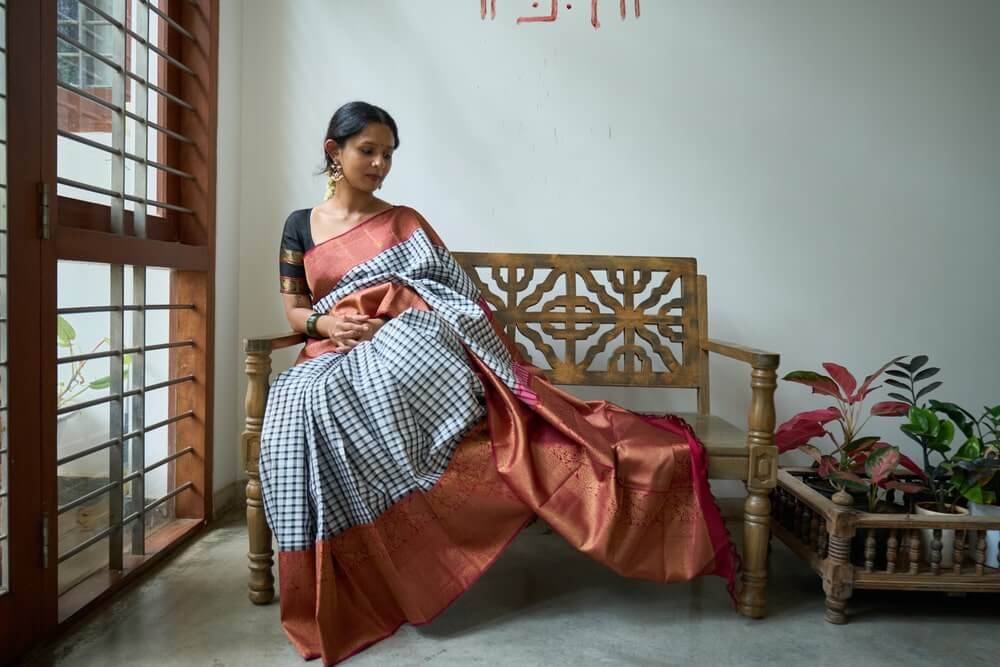
The first time I draped it, I understood what generations of women had always known. A Kanjeevaram changes the way a woman feels about herself. It is not loud or attention-seeking. Its beauty is quieter than that. The richness of the silk, the intricate zari, the elegance of the weave all come together to create something deeply graceful. A woman does not wear a Kanjeevaram to impress people. She wears it because it makes her feel connected to herself.
Perhaps that emotional connection also comes from knowing the craftsmanship behind every weave. Somewhere in Kanchipuram, artisans spend days, sometimes weeks, creating a single saree by hand. Every motif, every border, every thread carries years of inherited skill and artistry. There is patience woven into every inch of the fabric. In a world that moves quickly and mass produces almost everything, that kind of craftsmanship feels rare and deeply meaningful.
What makes Kanjeevaram sarees truly timeless is that they age beautifully alongside the women who own them. The silk softens gently over the years, the zari settles into a quieter glow, and the saree begins to carry the imprint of memories attached to it. A saree worn by a young bride eventually becomes the saree her daughter admires years later while opening the same cupboard she once opened as a child.
I have always believed that heirlooms are not valuable because they are expensive. They are valuable because they carry emotion from one generation to another. When a mother passes down her Kanjeevaram saree, she is not simply giving away silk and zari. She is passing on stories, blessings, memories, and a part of herself.
Even today, modern women who embrace contemporary fashion still hold a special place in their hearts for Kanjeevaram sarees. We may wear western silhouettes, experiment with trends, and live fast-paced lives, but there is something about returning to a Kanjeevaram that feels grounding. It reminds us of home, of family celebrations, of mothers and grandmothers who carried strength and elegance so effortlessly.
Maybe that is why brides across generations continue to dream of owning one. Not because it is traditional, but because it feels permanent in a world where everything else changes so quickly. A Kanjeevaram saree is never just about appearance. It is about memory, identity, and emotion woven together.
Even now, whenever I open my wardrobe and see my Kanjeevarams folded carefully on the shelf, I do not only see sarees waiting to be worn. I see future memories waiting to happen. Weddings yet to come, festivals yet to be celebrated, moments that will one day become stories for another generation.
And perhaps that is the timeless charm of a Kanjeevaram saree. Long after trends disappear and fashions change, it continues to remain what it has always been for Indian women: a piece of heritage wrapped in emotion.
FAQ’s
Why are Kanjeevaram sarees special? Kanjeevaram sarees are known for their pure silk, intricate zari work, rich weaving, and timeless craftsmanship.
How long do Kanjeevaram sarees last? With proper care, authentic Kanjeevaram sarees can last for decades.
Why are Kanjeevaram sarees expensive? They are handcrafted using premium silk and traditional weaving techniques that require exceptional skill and time.
Are Kanjeevaram sarees suitable for weddings? Yes. They are among the most popular bridal sarees for traditional Indian weddings.
How can I identify an authentic Kanjeevaram saree? Check the silk quality, weaving density, zari authenticity, and Silk Mark certification.