When you embark on the journey of shopping for authentic silk sarees, you will frequently encounter terms like “heirloom,” “handwoven,” “Korvai,” and “powerloom.” But what exactly is the heirloom saree meaning? And in an era of fast fashion and mass production, why does the distinction between a handloom and a powerloom saree matter so deeply?
Here is a comprehensive guide to understanding the true, intrinsic value of your silk saree, and why authentic handloom weaves are the ultimate, enduring heirloom.
What is an Heirloom Saree?
The “heirloom saree meaning” goes far beyond simply describing an old or expensive piece of clothing. An heirloom saree is a textile of such exceptional quality, masterful artistry, and emotional significance that it is intentionally preserved and passed down through generations—from a grandmother, to a mother, to a daughter, and beyond.
These are sarees that carry the weight of family history. They are worn at weddings, blessed at ceremonies, and stand the test of time, both in physical durability and stylistic relevance. Crucially, true heirloom sarees are almost exclusively handloom.
Handloom vs. Powerloom Silk Sarees: The Core Differences
To truly appreciate an heirloom, you must understand how it is made. The battle between handloom and powerloom is a battle between human artistry and mechanized speed.
1. The Craftsmanship, Time, and Human Touch
- Handloom: A handloom saree is woven entirely manually by highly skilled artisans on a wooden loom, without the use of electricity. Every single thread of the warp (length) and weft (width) is interlaced by the physical rhythm of the weaver’s hands and feet. A single, intricate Kanjeevaram—such as a complex Jacquard Kanjeevaram Saree—can take anywhere from 15 to 30 days of continuous labor to weave. The weaver’s skill, their mood, and their rhythm are permanently embedded in the fabric, making every single handloom saree a unique masterpiece.
- Powerloom: Woven by automated, electricity-driven mechanized looms, a powerloom can produce multiple identical sarees in a single day. The process is incredibly fast, entirely standardized, and completely lacks the human touch.
2. Texture, Breathability, and Drape
- Handloom: The tension of the threads in manual hand-weaving is organic. This creates a silk fabric that breathes, drapes beautifully around the curves of the body, and feels incredibly supple against the skin. You may notice tiny, microscopic irregularities (called slubs) in the weave; these are not defects, but rather the proud hallmark of human handloom weaving that adds deep character to the textile.
- Powerloom: The high-speed, rigid mechanical tension of a powerloom often results in a fabric that is significantly stiffer, flatter, and lacks the rich, multidimensional texture of handloom silk. It drapes rigidly and can feel harsh.
3. Zari, Borders, and Heritage Techniques
- Handloom: Authentic handloom Kanjeevarams rely on ancient weaving architectures. They use the labor-intensive Korvai technique to interlock a distinct, contrasting border with the main body, and the Petni technique for the pallu. This requires immense, specialized skill. Furthermore, heirloom sarees traditionally utilize techniques like the Vaira Oosi Kanjeevaram (diamond needle stripes woven intricately with zari).
- Powerloom: Machines cannot replicate the true Korvai interlocking. Powerloom designs are continuous, and borders are not genuinely interlocked. Furthermore, to keep costs low, they rely heavily on synthetic or half-fine zari (copper-based), which will inevitably tarnish, turn black, or fade over time.
4. Durability and Longevity
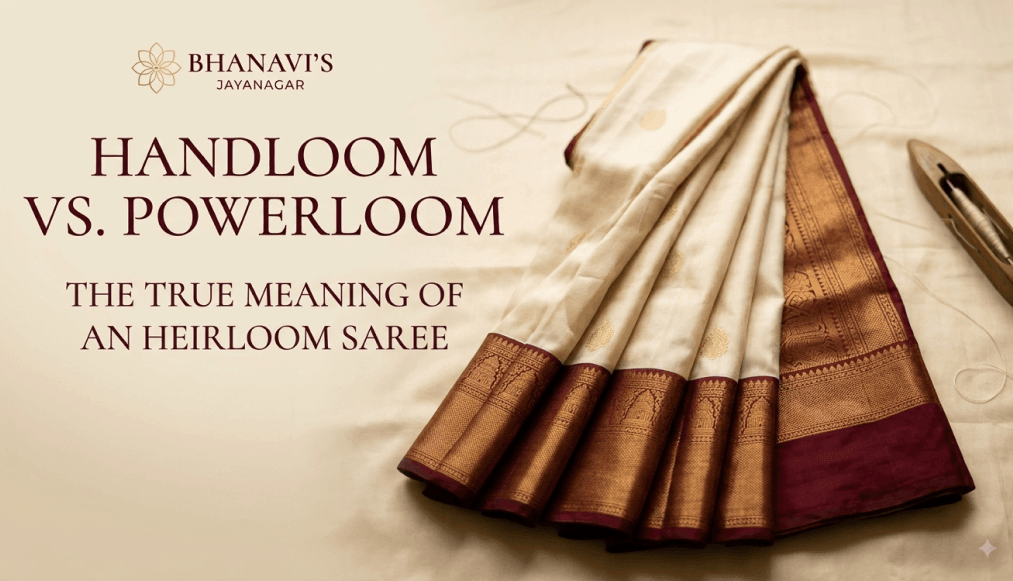
Because of the superior quality of pure mulberry silk and the organic tension of the hand-weaving technique, handloom sarees can literally last for decades. A Traditional Ivory and Maroon Kanjeevaram, if cared for properly, will maintain its luster and structural integrity for 50 years, making it a true heirloom. Powerloom sarees, subjected to the aggressive tension of machine weaving and utilizing cheaper materials, often fray, tear, or lose their shine much faster.
The Cultural Impact
By choosing handloom, you are not just buying a garment for a single occasion. You are actively sustaining centuries-old weaving communities, supporting sustainable, slow fashion, and investing in a true family heirloom that will tell your story long after you are gone.
Explore our genuine, meticulously crafted handwoven silk sarees and start weaving your own family’s legacy today.
Frequently Asked Questions (FAQ)
What exactly defines an heirloom saree? An heirloom saree is a textile of exceptional artistry and durability, meant to be preserved and passed down through generations. True heirlooms are almost always handloom.
How can I tell a handloom saree from a powerloom saree? Handloom sarees breathe better, drape suppler, and may have tiny microscopic irregularities that indicate human touch. Powerloom sarees are stiffer and perfectly uniform.
Why is the Korvai technique important in Kanjeevarams? Korvai is a complex hand-weaving technique used to interlock contrasting borders to the body. Machines cannot genuinely replicate this interlocking weave.
How long does a pure handloom Kanjeevaram last? With proper care, a pure mulberry silk handloom Kanjeevaram can maintain its luster and structural integrity for decades, easily lasting over 50 years.